Front Loader vs. Belly Washer vs. Rotary Drum: How Machine Type Changes Enzyme Wash Behavior
Machine type changes the way enzymes meet denim. The same recipe can deliver a clean vintage fade in one washer and a flat, uneven, backstained result in another.
For any laundry evaluating an enzyme supplier for denim washing, the question is not only which enzyme chemistry to use. It is whether the enzyme package can be adapted to the mechanical profile of the plant: drum geometry, liquor movement, load compression, fabric-to-fabric contact, foam control, temperature drift, and drain behavior.
RivetTide works with denim laundries where finish repeatability matters: consistent shade panels, controlled abrasion targets, lower rewash risk, and fabric handfeel that matches the buyer sample across bulk production.
Why washer type changes enzyme behavior
Enzyme washing is not a static chemical step. It is a mechanical-biochemical finishing process.
Three variables decide how the enzyme behaves inside the machine:
- Contact pattern: how often enzyme solution reaches the yarn surface.
- Mechanical action: how much rubbing, folding, impact, and fabric compression occurs.
- Liquor movement: how quickly loosened indigo, fiber fragments, and soils move away from the garment.
When these variables shift, the finish shifts. A cellulase system that gives balanced contrast in a rotary drum may generate excess edge wear in a compact front loader. A formulation that minimizes backstaining in a belly washer may need a different dispersing and anti-redeposition balance in a higher-friction drum.
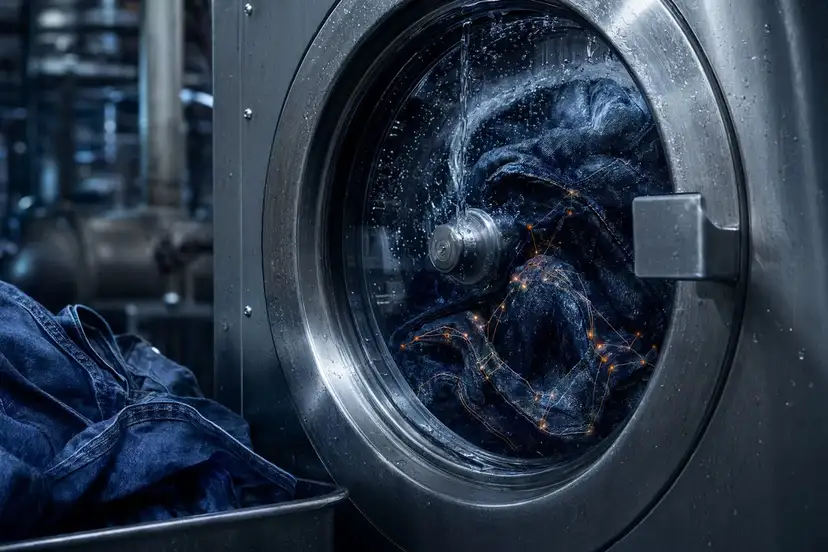
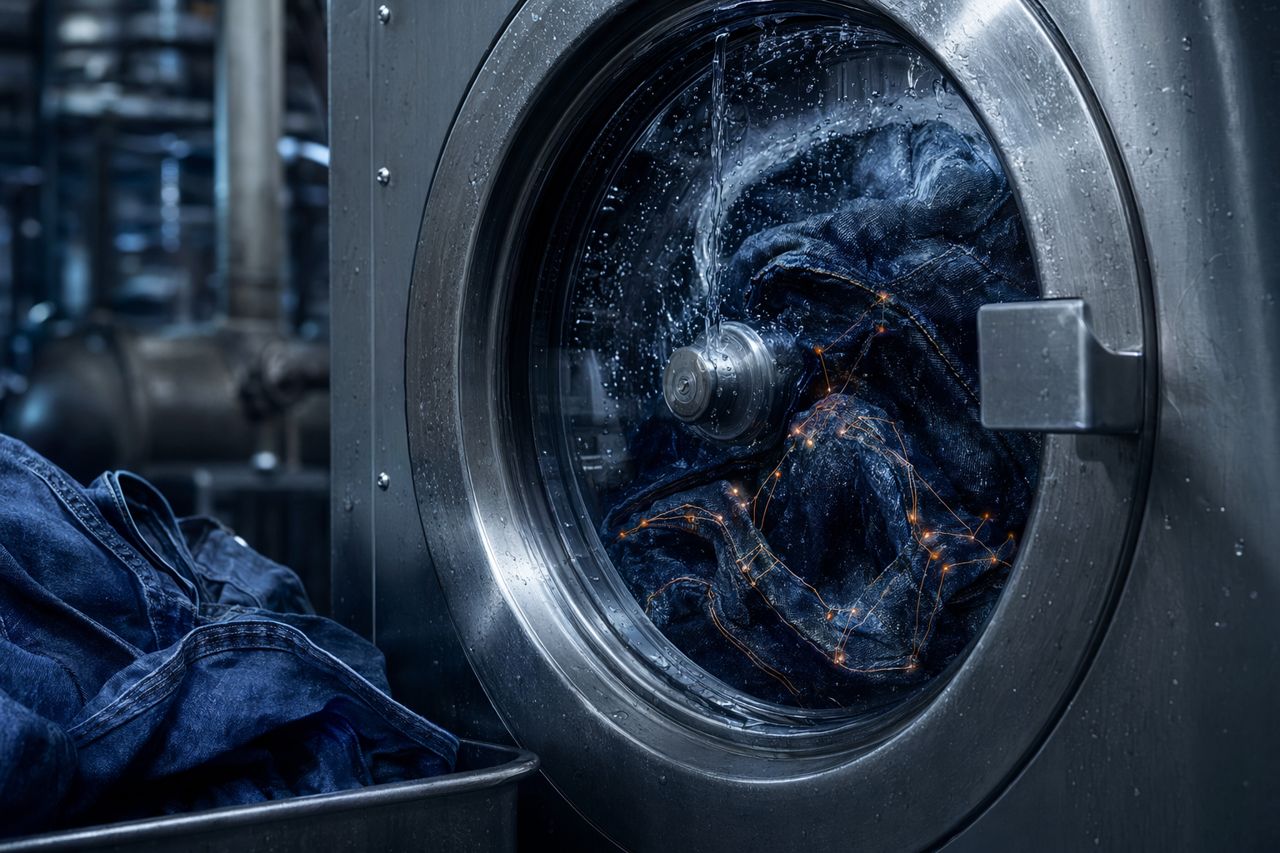
Front loaders: compact action, strong fabric compression
Front loaders are common in sample rooms, smaller production cells, and laundries running mixed garment styles. They can produce sharp character when controlled well, but the mechanical profile is concentrated.
What happens inside the machine
Front loaders typically create:
- Higher garment compression at the lower drum zone
- Repeated lift-and-drop action in a compact space
- Localized friction at seams, waistbands, pockets, and hems
- Faster variation when load size changes
- Greater sensitivity to foam and liquor ratio
Enzyme behavior to watch
In front loaders, enzyme contact can be uneven if the load is too dense or liquor flow is restricted. This may show up as:
- Strong seam abrasion but weak panel opening
- Patchy thigh or knee shade movement
- Higher rewash risk on dark indigo lots
- More visible backstaining if loosened dyestuff is not dispersed quickly
- Handfeel variation between the outer and inner garments in the load
RivetTide formulation priorities for front loaders
For front-loader production, RivetTide focuses on enzyme systems with controlled surface action, clean rinse-out behavior, and anti-redeposition support. The goal is to open the fabric face without overcutting high-contact areas.
Best-fit production objectives include:
- Medium abrasion with controlled seam brightness
- Cleaner blue cast on dark and mid washes
- Lower backstaining on pocketing and weft exposure
- Shorter correction cycles after bulk inspection
- Better consistency between sample and production loads
Belly washers: high volume, broad movement, slower response
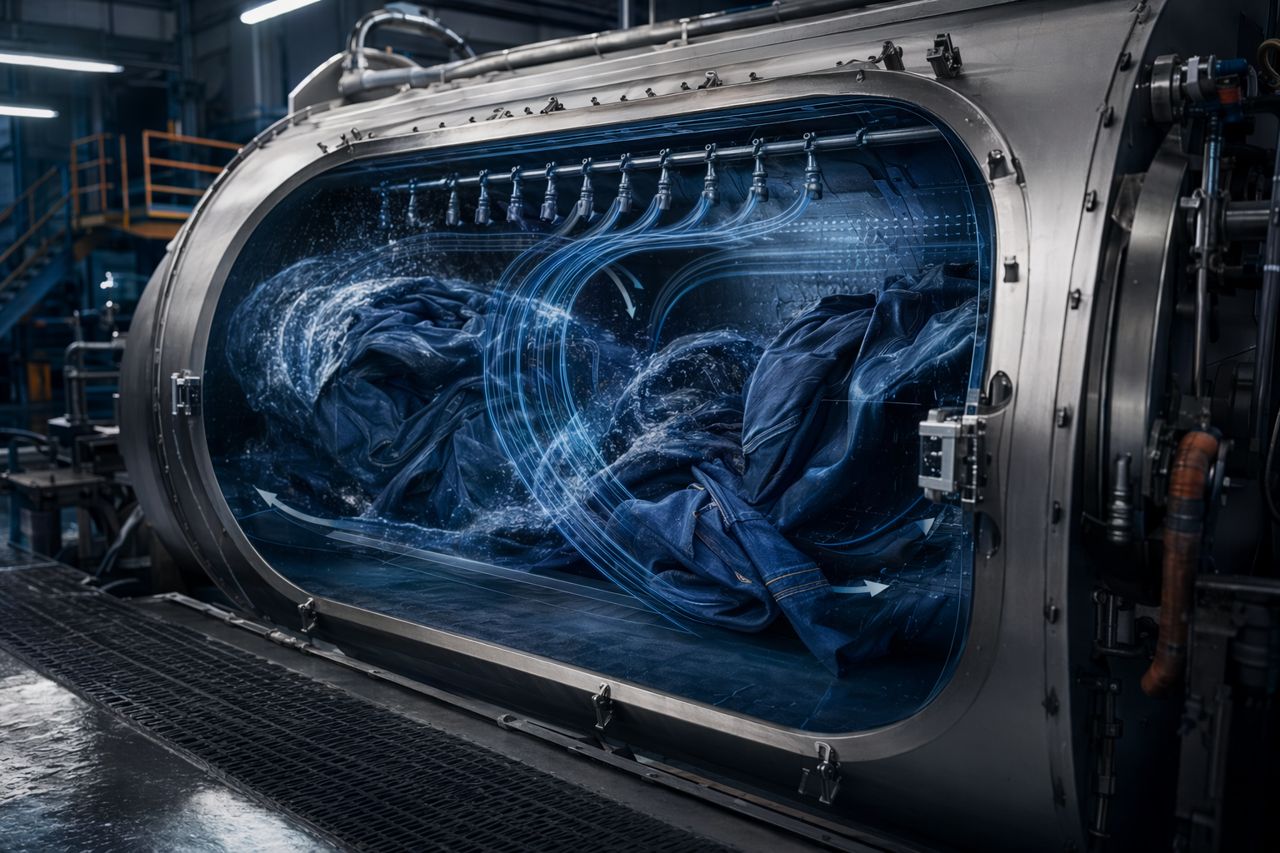
Belly washers are built for volume. Their large body and open movement can give good batch blending, but enzyme response may be slower and more dependent on water movement.
What happens inside the machine
Belly washers usually create:
- Larger garment movement paths
- Broader liquor circulation
- Lower localized impact compared with compact drums
- More gradual shade development
- Strong dependence on loading discipline and water level
Enzyme behavior to watch
Belly washers can produce smooth, even shades, but laundries often see slower abrasion build or softer contrast. If the enzyme package is not matched to the movement profile, the result can look washed but under-defined.
Common issues include:
- Good overall shade drop but weak high-low contrast
- Longer cycle time to reach buyer-approved panels
- Flat handfeel if processing is extended too far
- Backstaining risk when indigo remains suspended too long
- Variation between top-loaded and bottom-loaded garment zones
RivetTide formulation priorities for belly washers
For belly-washer use, RivetTide emphasizes efficient fabric-face action and strong bath management. The enzyme system must keep working across a large circulating volume while supporting shade uniformity.
Best-fit production objectives include:
- Even panel fading across larger batches
- Reduced extended-wash dependency
- Better control of grey cast and redeposition
- Stable results across dark, medium, and vintage programs
- Handfeel retention without harsh overprocessing
Rotary drums: active tumbling, strong abrasion control potential
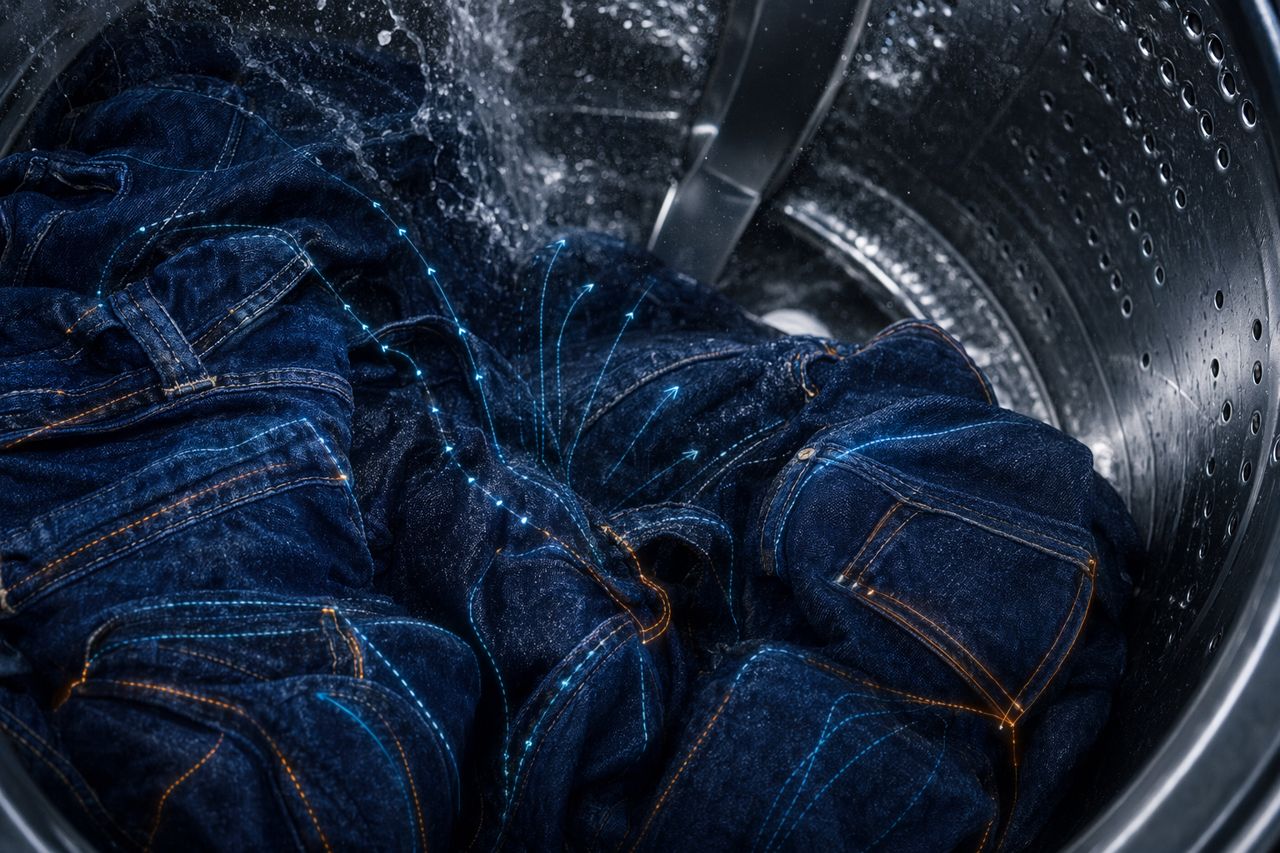
Rotary drum systems are highly effective for denim character development. Their kinetic profile supports fabric-to-fabric abrasion and, where desired, pumice-free or reduced-stone finishing concepts.
What happens inside the machine
Rotary drums typically create:
- Continuous garment turnover
- Strong fabric-to-fabric contact
- Good liquor exchange when loading is balanced
- Predictable mechanical abrasion windows
- Fast visual response on seams, whisker areas, hems, and pocket edges
Enzyme behavior to watch
Rotary drums can deliver excellent contrast, but they also expose weak recipe control quickly. If the enzyme action is too aggressive for the mechanical profile, damage risk rises before the target shade is reached.
Potential issues include:
- Overbright seam and pocket edges
- Excess lint and fiber loss
- Reduced tensile retention on lighter constructions
- Harsh handfeel after extended abrasion
- Inconsistent results when drum loading changes between styles
RivetTide formulation priorities for rotary drums
For rotary drum finishing, RivetTide builds around controlled abrasion, clean indigo release, and lower redeposition pressure. The target is strong denim character without pushing the garment into a rework zone.
Best-fit production objectives include:
- Clear abrasion targets with lower damage risk
- Pumice-free or reduced-stone process support
- More stable shade progression during bulk runs
- Cleaner pocketing and inner-surface appearance
- Better repeatability across multiple wash lots
Machine comparison: what laundry managers should control
| Production factor |
Front loader |
Belly washer |
Rotary drum |
| Mechanical intensity |
Concentrated and compact |
Broad and gradual |
Active and repeatable |
| Main risk |
Local over-abrasion and patchiness |
Flat shade or extended cycle |
Excess contrast or fiber loss |
| Backstaining pressure |
High when bath movement is restricted |
High when dyestuff remains suspended |
Moderate to high during fast abrasion |
| Shade control requirement |
Tight load and foam control |
Strong circulation and bath balance |
Controlled abrasion window |
| Enzyme priority |
Surface control and anti-redeposition |
Efficient response in larger liquor movement |
Abrasion precision and clean rinse behavior |
Practical recipe implications
Changing washer type should trigger a recipe review. A direct transfer is rarely reliable.
1. Re-check the abrasion target
Define the finish before changing chemistry. Is the buyer asking for soft vintage wash, salt-and-pepper contrast, clean medium shade, or aggressive worn edge? The machine determines how quickly that target appears.
2. Control load density before blaming chemistry
Load discipline is one of the most common causes of shade variation. Overloaded front loaders restrict liquor exchange. Underloaded rotary drums can create excessive impact. Belly washers need balanced movement so garments do not separate into slow and fast zones.
3. Watch the first rinse
The first rinse tells the truth. If loosened indigo is not moving away from the garment, backstaining risk rises. A strong enzyme system should be supported by bath management that keeps the surface clean and prevents redeposition.
4. Do not extend time as the first correction
Adding wash time may deepen shade movement, but it can also flatten handfeel, raise fiber loss, and increase rewash variability. A better correction may be enzyme selection, process temperature, dispersing support, or mechanical loading.
5. Validate against bulk, not only samples
Sample machines often exaggerate or understate enzyme performance. Bulk validation should compare shade, seam abrasion, pocketing cleanliness, handfeel, tensile expectations, and rewash rate across the actual production washer.
Buyer value: less correction, more repeatable finish
For denim laundries, enzyme selection is a production control decision. The right system helps reduce the gap between approved sample and bulk shipment.
RivetTide supports laundries looking to improve:
- Batch-to-batch shade consistency
- Abrasion repeatability across machine types
- Backstaining reduction on pocketing and garment interiors
- Fabric handfeel without unnecessary process extension
- Water-temperature flexibility in real laundry conditions
- Cycle-time discipline and reduced rewash pressure
- Cleaner transitions from sample development to bulk production
When to review your enzyme system
Review your denim enzyme program if you see any of the following:
- One machine type consistently misses shade while another passes
- Front loaders create strong seams but weak panels
- Belly washers need extended processing to reach the approved look
- Rotary drums hit contrast quickly but increase damage complaints
- Pocketing shows grey cast or indigo redeposition
- Bulk lots pass after rewash instead of first time
- Handfeel changes when cycle time is extended
These are not only operator issues. They often indicate that the enzyme package is not matched to the washer’s mechanical behavior.
RivetTide approach
RivetTide supplies enzyme solutions for denim laundries that need controlled finishing behavior across different washer platforms. We look at the machine first, then the recipe: fabric construction, indigo depth, garment load, target abrasion, water temperature range, rinse pattern, and rewash history.
The result is a practical enzyme recommendation built for production, not a generic washroom trial.
Request a quote
If you are comparing enzyme performance across front loaders, belly washers, or rotary drums, RivetTide can help match the formulation to your machine profile and finish target.
Request a quote through the on-site form and share your washer type, garment category, target shade, and current process challenge.