Pumice, Synthetic Stone, and Enzyme-Only Abrasion: A Denim Laundry Cost and Waste Comparison
For denim laundries, abrasion method is not only a style decision. It affects batch consistency, machine loading, drainage load, rewash risk, fabric strength, handfeel, and how tightly the wash floor can hold a target shade across repeated production.
Traditional pumice still has a place in some finishing recipes. Synthetic stones offer a cleaner, more controlled stone-wash profile. Enzyme-only abrasion reduces solid waste and can give laundries more control over shade development, especially when paired with disciplined dosing, temperature management, and backstaining control.
RivetTide works as an enzyme supplier for denim washing focused on practical laundry outcomes: repeatable abrasion targets, cleaner indigo removal, lower rewash exposure, flexible wash temperatures, and production-ready finishing systems.
The short comparison
| Abrasion route |
Main value |
Main cost pressure |
Waste profile |
Process control |
Best fit |
| Pumice stone |
Strong physical abrasion and authentic worn-down highs |
Stone purchase, handling, machine wear, garment damage, cleanup |
High solid waste, sludge, pocket residue, pumice dust |
Variable as stones break down |
Rugged, heavy vintage looks where stone character is intentional |
| Synthetic stone |
More consistent mechanical action than natural pumice |
Reuse tracking, replacement cost, stone management |
Lower breakup than pumice, but still a solid media stream |
More stable than pumice |
Controlled stone-wash effects with reduced debris |
| Enzyme-only abrasion |
Cleaner process, reduced solids, better dosing control |
Requires recipe discipline and enzyme selection |
Low solid waste, lower cleanup load |
High when dosage, pH, time, temperature, and garment load are controlled |
Consistent fades, softer handfeel, lower rewash risk, pumice-free programs |
1. Pumice: familiar abrasion with real floor costs
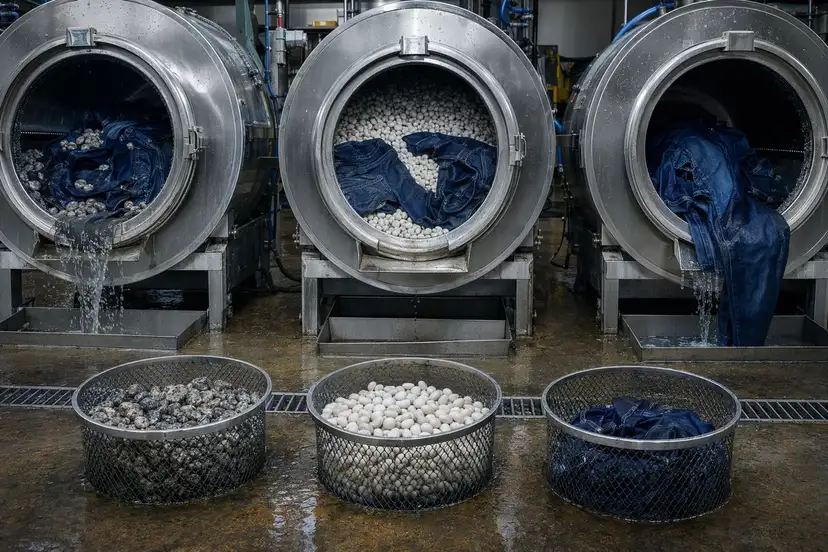
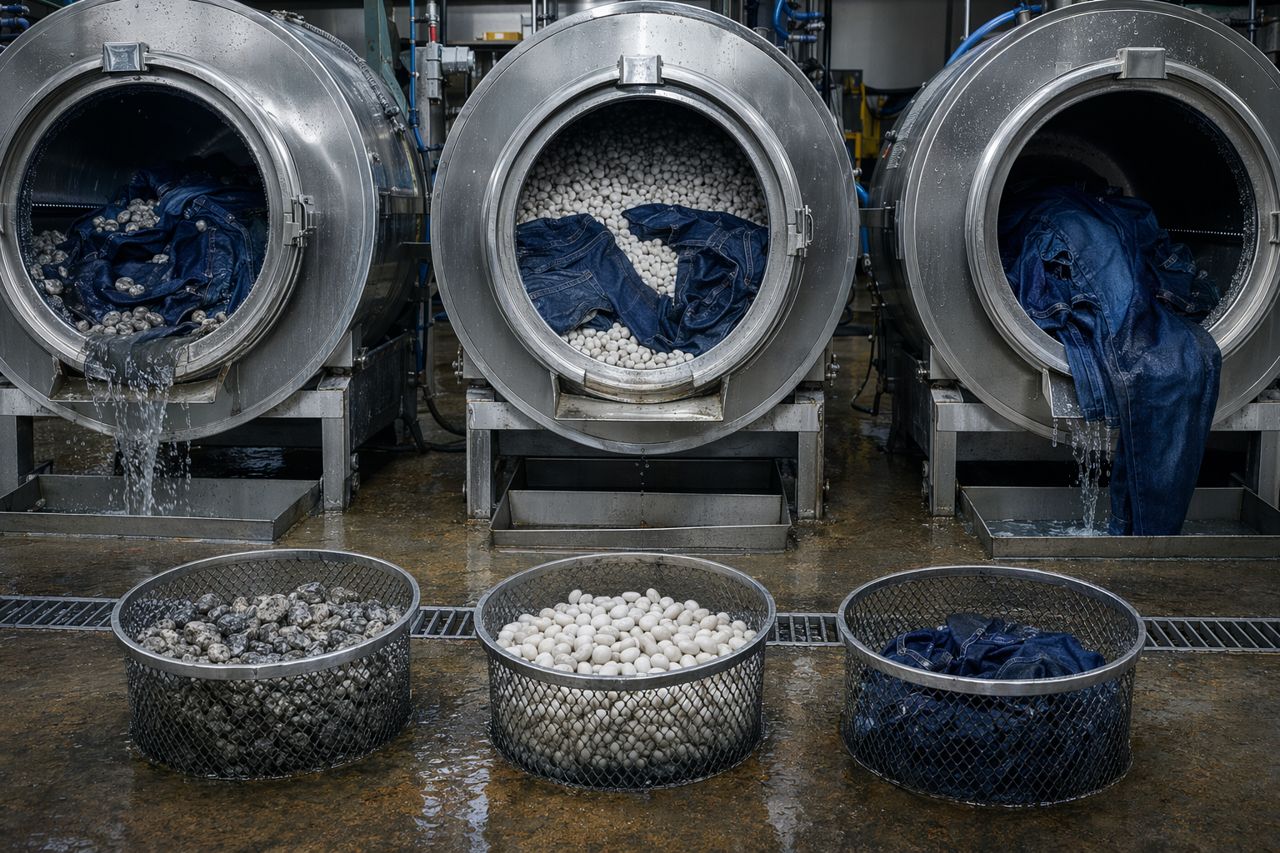
Pumice gives denim laundries a direct mechanical abrasion effect. The stones strike seams, thighs, hems, pocket edges, and raised fabric areas, helping generate high-low contrast and a worn garment surface.
The challenge is that pumice does not behave like a fixed process input. Stones fracture, round off, and shed particles through the run. This changes abrasion intensity from batch to batch and can create downstream issues.
Operational costs with pumice
Pumice cost is not limited to the stone invoice. Laundry managers also carry costs from:
- Stone loading, unloading, sorting, and disposal
- Additional rinse demand to clear debris
- Pumice dust and sediment in drains and filters
- Manual pocket cleaning and garment inspection
- Higher risk of machine abrasion and drum wear
- Garment damage from aggressive impact or trapped fragments
- Rewash or repair when shade and abrasion drift outside target
Where pumice still makes sense
Pumice can still be useful where a brand wants a heavy, irregular, rugged stone-wash signature. It may also be familiar to operators and easy to understand visually during sampling.
But for laundries under pressure to reduce solid waste, protect equipment, and hold shade consistency over repeat orders, pumice can become a control problem.
2. Synthetic stone: cleaner mechanics, still media-dependent
Synthetic stones were developed to reduce some of the variability and mess associated with natural pumice. They generally deliver a more uniform mechanical action and can be reused depending on the material, recipe, and laundry practice.
For plants that want to keep a stone-wash aesthetic but reduce breakage and sediment, synthetic stone can be a practical middle route.
Benefits over pumice
- More consistent size and shape profile
- Lower fragmentation compared with natural pumice
- Reduced pocket debris and sediment load
- Easier process standardization across wash lines
- Better compatibility with controlled enzyme-assisted recipes
Remaining limits
Synthetic stone is still a physical media system. It must be stored, loaded, removed, tracked, cleaned, and replaced. It still takes drum volume. It can still affect garment-to-garment contact patterns. It can still contribute to fabric stress if the recipe is too aggressive.
For laundries scaling premium denim programs, the question is not only whether synthetic stone is cleaner than pumice. The larger question is whether the finish can be achieved with less media, less handling, and tighter enzyme-driven control.
3. Enzyme-only abrasion: less solid waste, tighter recipe control
Enzyme-only abrasion uses cellulase-driven surface modification to loosen indigo-bearing fibers and create controlled fading without relying on stones as the primary abrasion source. In the right program, this approach supports cleaner drainage, improved handfeel, and more repeatable shade development.
The main advantage is controllability. Instead of managing a changing mass of stones inside the machine, the laundry controls recipe factors: enzyme selection, dosage band, liquor ratio, time, temperature, pH, garment load, mechanical action, and stop conditions.
RivetTide enzyme systems are developed for denim laundries that need dependable performance across bulk production, not just attractive lab panels.
Practical advantages of enzyme-only programs
- Reduced solid waste and lower cleanup burden
- Less pocket residue and fewer stone-removal steps
- Better fabric handfeel compared with harsh mechanical abrasion
- Lower garment damage risk when the process is tuned correctly
- More consistent shade movement from batch to batch
- Flexible performance across practical laundry temperatures
- Better compatibility with backstaining-control strategies
- Easier documentation for repeat orders and customer approvals
What enzyme-only does not replace automatically
Enzyme-only abrasion is not a one-click substitute for every stone-wash look. Very heavy seam wear, random stone marks, and aggressive vintage highs may still require mechanical assistance, laser, ozone, hand work, or a hybrid process.
The strongest results come when the laundry defines the target: soft fade, salt-and-pepper, low backstain, mid-blue washdown, high-low contrast, or abrasion without garment damage. The enzyme recipe should be built around that target.
Cost comparison: where the money moves
A fair cost comparison should include more than the price of stone or enzyme. The real cost sits across the whole batch.
Cost areas to review
| Cost area |
Pumice |
Synthetic stone |
Enzyme-only |
| Media purchase |
Recurring |
Recurring or tracked reuse |
None for stones |
| Chemical cost |
Often enzyme-assisted |
Often enzyme-assisted |
Enzyme is the core process input |
| Handling labor |
High |
Medium |
Low |
| Cleanup labor |
High |
Medium |
Low |
| Drain and sludge burden |
High |
Medium |
Low |
| Machine wear exposure |
Higher |
Medium |
Lower |
| Garment damage risk |
Higher if uncontrolled |
Medium |
Lower when tuned |
| Rewash risk |
Can rise with stone variability |
Lower than pumice |
Lower when recipe is stable |
| Process documentation |
Harder due to stone breakdown |
Moderate |
Stronger recipe repeatability |
The best economic case for enzyme-only abrasion usually appears when laundries measure hidden costs: cleanup time, water used for debris removal, drain maintenance, garment rejects, rewash batches, and machine downtime.
Waste comparison: solid load matters
Denim finishing already carries water, color, lint, chemistry, and sludge management challenges. Abrasion media adds another layer.
Pumice waste profile
Pumice creates physical residue. Broken stone, dust, and sediment can move through garments, pockets, drums, filters, and drains. This affects housekeeping and can complicate wastewater handling.
Synthetic stone waste profile
Synthetic stone can reduce breakup and sediment but does not eliminate media management. Reuse cycles, cleaning, and end-of-life disposal still need control.
Enzyme-only waste profile
Enzyme-only abrasion removes the stone stream from the recipe. The laundry still manages indigo, lint, and process water, but the solid abrasion media burden is significantly reduced. This can support cleaner machines, simpler unloading, and less post-wash debris inspection.
Shade control and backstaining
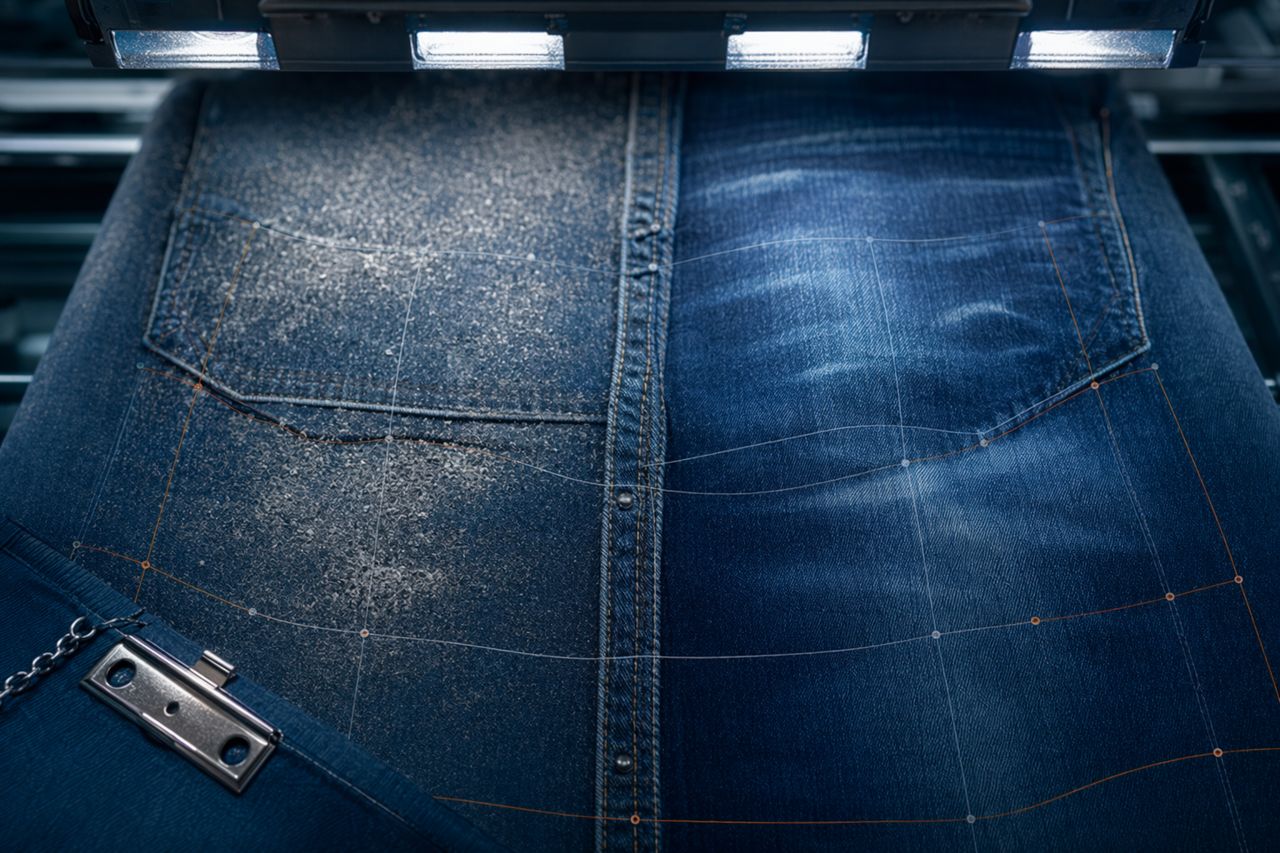
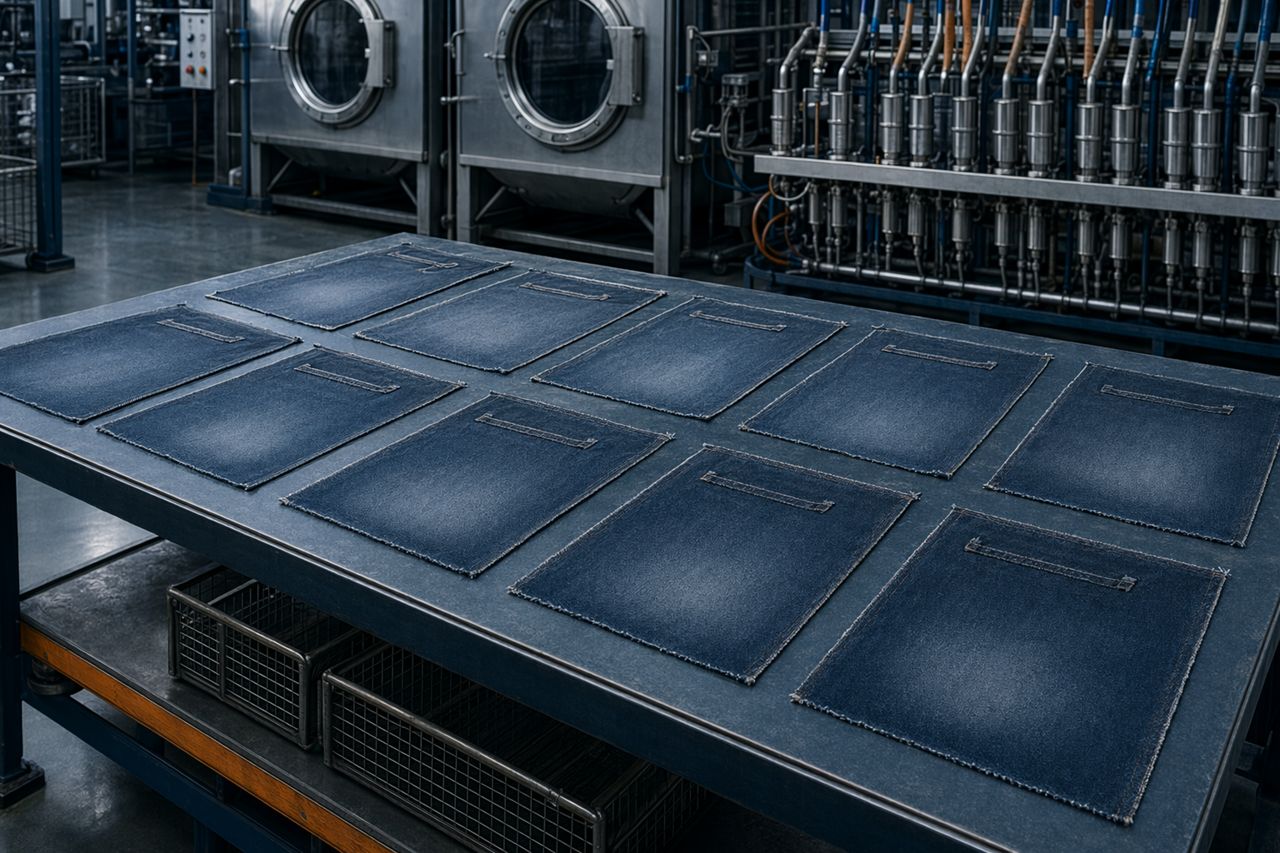
In denim laundry, abrasion quality is judged by the shade panel, not by the recipe sheet. A process is only valuable if it delivers the approved look repeatedly.
Pumice can give strong abrasion but may increase shade variability as stones break down or distribute unevenly in the drum. Synthetic stones improve this profile but still depend on garment-media contact.
Enzyme-only systems can give more controlled shade movement because the main abrasion driver is recipe-based. With the right cellulase package and anti-backstaining support, laundries can improve indigo release while limiting redeposition on pocketing, weft yarns, labels, and lighter fabric zones.
Key control points include:
- Garment load and drum action
- Starting fabric construction and dye depth
- Temperature window and pH control
- Enzyme selection for the target finish
- Time to shade and stop procedure
- Rinse sequence and backstaining management
- Consistent neutralization or enzyme deactivation step where required
Fabric handfeel and strength protection
Aggressive mechanical abrasion can create strong visual effects, but it may also increase fabric stress. Seams, hems, belt loops, pockets, and stretch fabrics are especially sensitive.
Enzyme-only abrasion can support a softer handfeel with less harsh impact. For stretch denim, lightweight fabrics, or premium programs where the customer expects a clean touch and controlled drape, this can be a major advantage.
That said, enzyme selection matters. A poorly matched enzyme program can over-soften, weaken the surface, or create uneven shade. A production-ready enzyme supplier should help the laundry tune the recipe to the fabric, target shade, machinery, and cycle time.
Cycle time and rewash prevention
A shorter recipe is not always the lowest-cost recipe. If the batch needs correction, extra rinsing, sorting, or reprocessing, the floor loses capacity.
Enzyme-only programs can reduce non-value-added steps tied to stone removal and debris cleanup. They can also improve first-pass approval when shade development is predictable.
For laundry managers, the useful target is not maximum speed. It is stable cycle time with fewer surprises.
Decision guide: which route fits your program?
Choose pumice when:
- The buyer wants a heavy, irregular, stone-driven vintage look
- Solid waste and cleanup are acceptable for the product tier
- The laundry has established stone handling and drain maintenance systems
- The style depends on physical stone character
Choose synthetic stone when:
- You need a stone-wash look with better media consistency
- You want less breakup than natural pumice
- The production team can track reuse and replacement
- A hybrid enzyme-plus-media process gives the right panel
Choose enzyme-only abrasion when:
- You want pumice-free or low-solid-waste finishing
- Batch-to-batch shade control is a priority
- Backstaining reduction is critical
- Fabric handfeel and strength protection matter
- You need practical water-temperature flexibility
- You want fewer cleanup steps and less machine debris
- Rewash prevention is a key cost target
How RivetTide supports denim laundries
RivetTide supplies enzyme solutions for denim washing programs where production control matters. We help laundries build enzyme-only and hybrid recipes around the real constraints of the floor: machine type, garment load, target shade, fabric construction, temperature range, rinse sequence, and customer approval standards.
Our focus areas include:
- Cellulase systems for controlled denim abrasion
- Backstaining-reduction support for cleaner cast and pocketing
- Enzyme programs for soft handfeel and shade repeatability
- Pumice-reduction and pumice-free finishing routes
- Recipe adjustment for bulk consistency and rewash prevention
- Support for laundries moving from sample success to production stability
Bottom line
Pumice delivers familiar mechanical abrasion, but it carries hidden costs in waste, labor, machine wear, debris, and variability. Synthetic stone improves control but still depends on media handling. Enzyme-only abrasion reduces the solid burden and gives laundries a more recipe-driven route to consistent shade, softer handfeel, and lower rewash exposure.
For denim laundries facing tighter customer tolerances and cleaner production expectations, the best route is often not one universal method. It is a controlled abrasion strategy matched to the garment, target panel, and production line.
Request a quote
Planning a pumice-reduction, synthetic-stone hybrid, or enzyme-only denim abrasion program? Send your target shade, fabric type, machine format, batch size, and current wash sequence through the on-site request form. RivetTide will review the application and recommend an enzyme approach built for production control.
Request a quote